
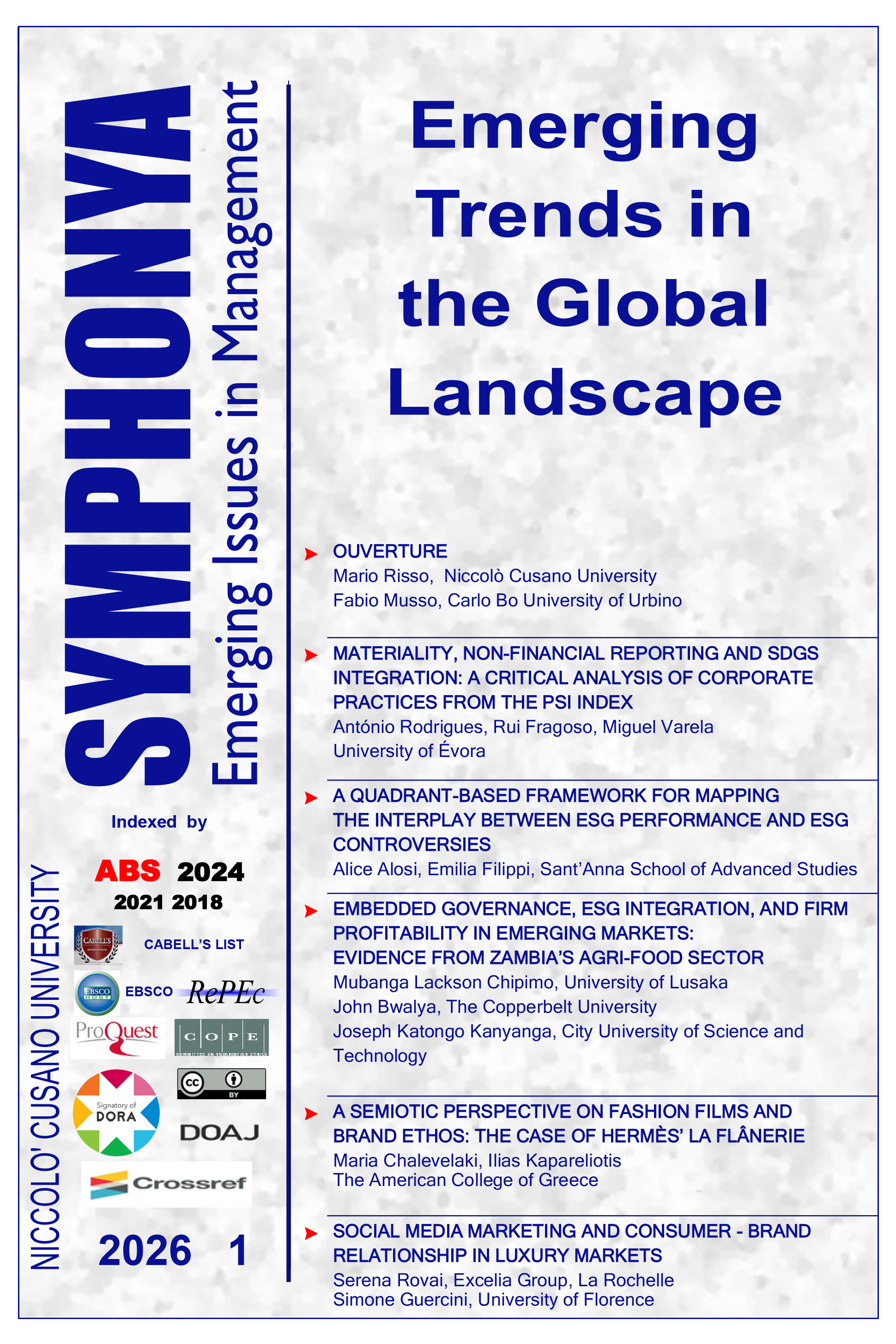
Embedded Governance, ESG Integration, and Firm Profitability in Emerging Markets: Evidence from Zambia’s Agri-Food Sector
DOI:
https://doi.org/10.4468/2026.1.04chipimo.bwalya.kanyangaKeywords:
Embedded Governance, ESG Integration, Emerging Markets, Corporate Governance, Sustainable Competitiveness, Agri-Food SectorAbstract
This paper focuses on the role of embedded corporate governance in the integration of environmental, social and governance (ESG) and firm profitability in emerging markets. The study adopts an explanatory sequential mixed-methods design comprising panel regression analysis of governance and financial indicators for the period 2014-2024, and qualitative analysis of ESG disclosures based on ISO IWA 48:2024, based on evidence from the listed agri-food sector in Zambia. Baseline governance models showed weak relationships with profitability across the panel estimators. Although governance did not demonstrate a statistically significant direct association with short-term accounting profitability, the qualitative findings consistently showed that governance strengthens accountability, stakeholder trust, organisational resilience and ESG integration. These findings support an embedded governance perspective in which governance contributes to sustainable competitiveness primarily through organisational capability rather than immediate financial gains. The results have managerial and policy implications for improving sustainable competitiveness in resource constrained and institutionally fragile settings.
Downloads
Published
How to Cite
Issue
Section
License
Copyright (c) 2026 Symphonya. Emerging Issues in Management

This work is licensed under a Creative Commons Attribution 4.0 International License.
The authors retain all rights to the original work without any restrictions.
License for Published Contents

You are free to copy, distribute and transmit the work, and to adapt the work. You must attribute the work in the manner specified by the author or licensor (but not in any way that suggests that they endorse you or your use of the work).
License for Metadata

Symphonya published articles metadata are dedicated to the public domain by waiving all publisher's rights to the work worldwide under copyright law, including all related and neighboring rights, to the extent allowed by law.
You can copy, modify, distribute and perform the work, even for commercial purposes, all without asking permission.